Resolution (1) of the First Pan-European Congress of Azerbaijani Political Exiles and Exiled Media on the Political and Socio-Economic Situation in Azerbaijan and the Tasks Facing Democratic Forces
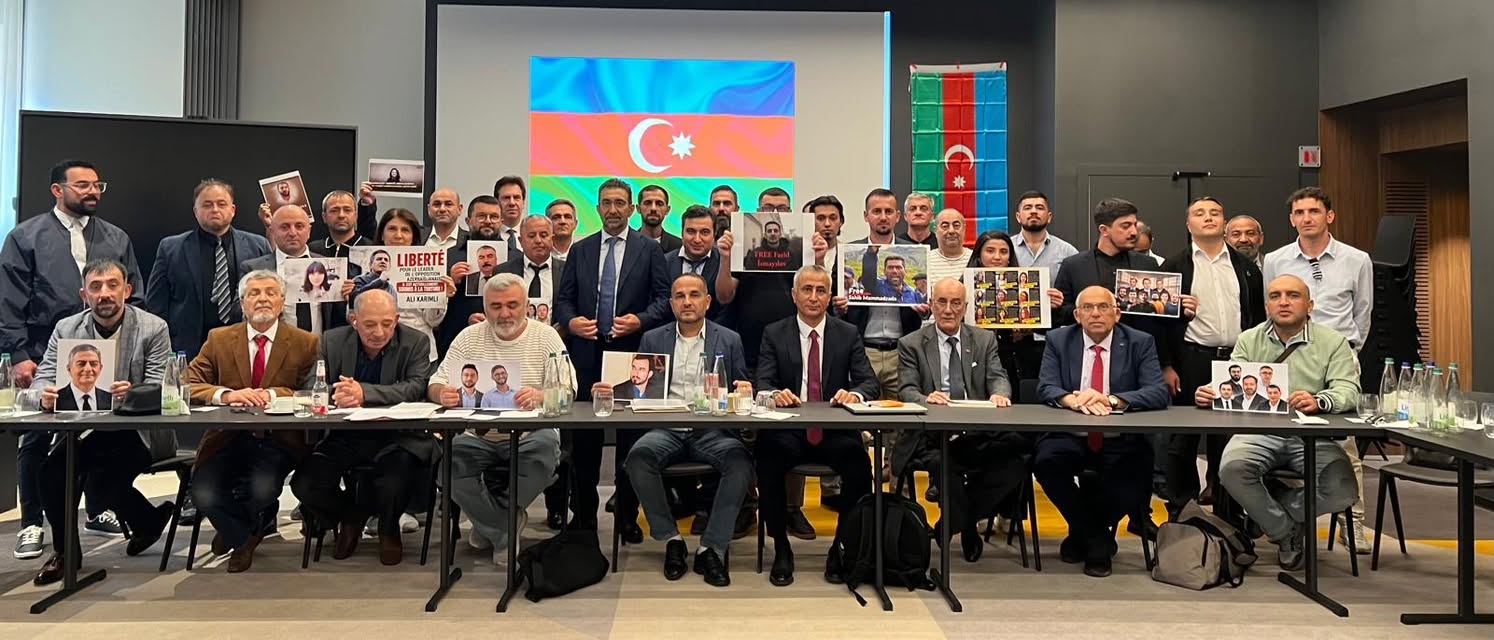
The First Pan-European Congress of Azerbaijani Political Emigrés and Exiled Media was held on September 26 in Strasbourg, France. The Congress heard special reports on 15 topics, followed by serious debates and discussions, and concluded successfully.
We are publishing on our website the resolutions adopted by the Congress, as well as its appeals to the European Union, the Council of Europe, the OSCE, the governments of democratic states, international financial institutions, investors, and mass media organizations. A video report on the Congress will be available on the Azerbaijani Saat YouTube channel. We will add the link to our website as soon as the report is ready.
***
The participants of the First Pan-European Congress of Azerbaijani Political Exiles and Exiled Media, having discussed the political, social and economic situation in Azerbaijan, the nature of the state system, the intensification of repression, and the tasks facing democratic forces during a possible transition period, hereby adopt this Resolution.
Findings
The First Pan-European Congress of Azerbaijani Political Exiles and Exiled Media finds that the authoritarian system in Azerbaijan has reached an unprecedented level of political, administrative and economic centralisation.
The principal state institutions — parliament, the judiciary, local self-government bodies, electoral commissions and executive structures — have been deprived of genuine independence and subordinated to a single centre of decision-making.
The constitutional principle of the separation of powers is, in practice, non-functional. Parliament does not exercise effective oversight over the executive branch; the judiciary is not independent; and elections do not ensure the free expression of citizens’ will, genuine political competition or the peaceful transfer of power.
Political parties, independent media outlets and civil society organisations operate under legislative restrictions, administrative pressure and criminal prosecution. Freedom of expression, peaceful assembly, association and political activity exist largely in formal terms and are systematically restricted through legislation, subordinate regulations and the practices of state authorities.
Any political or civic activity outside the control of the authorities is regarded as a threat to the existing system. Criticism of the government, investigative journalism, human rights advocacy, participation in peaceful protests and posts on social media may become grounds for criminal prosecution.
There are more than 350 political prisoners in Azerbaijan. They include leaders and activists of opposition parties, journalists, human rights defenders, civil society representatives, academics, religious activists, as well as citizens persecuted for peacefully expressing their views.
The Congress considers that, in the absence of genuine political competition, an independent judiciary and free media, repression is gradually becoming one of the principal instruments for preserving power and enforcing political loyalty.
Economic Situation
The Congress finds that political centralisation is accompanied by the monopolisation of the economy and the concentration of property and financial resources in the hands of the ruling family and groups associated with it.
Previously existing independent regional and sectoral economic centres have been dismantled. Their leaders have been reduced to appointed administrators lacking independence and excluded from meaningful strategic decision-making.
The concentration of political power, major property holdings and administrative resources has impeded the development of free enterprise, competition and a strong middle class. The absence of an independent judiciary and reliable guarantees of property rights creates a permanent risk for businesses and constrains long-term investment.
The level of the shadow economy remains high. Society has no reliable access to information concerning the ultimate beneficial owners of the largest companies, the origins of major fortunes, the actual income of those controlling key economic assets, or their tax obligations.
Despite Azerbaijan having generated substantial oil and gas revenues for many years, it lags behind Armenia and Georgia in a number of important indicators, including nominal GDP per capita and average wages. This demonstrates the inefficient use of national resources and the unjust distribution of public wealth, with the country’s wealth being ruthlessly plundered by a narrow group.
Monetary policy also fails to adequately support the development of domestic production. Despite sustained increases in domestic prices, the manat’s exchange rate has remained practically unchanged, creating advantages for imports. The effectively high cost of credit restricts the capacity of industry, agriculture and small and medium-sized enterprises to obtain long-term financing.
As a result, imports of finished goods are often more economically advantageous than domestic production. This leads to the outflow of foreign currency, the financing of jobs abroad and the contraction of Azerbaijan’s domestic production base.
Declining oil production and oil and gas revenues, slowing economic growth, constrained budgetary resources, the consolidation of state structures and companies, and the resulting reduction in employment create additional risks.
Declining incomes among civil servants, employees of state-owned companies and members of the middle class will weaken domestic demand, shrink the consumer market and further deteriorate the economic situation.
The Congress considers that the existing model lacks effective mechanisms for self-reform. Political and economic monopolisation prevents changes capable of limiting the influence of the ruling family, ensuring judicial independence and creating conditions for fair competition.
As economic and social problems deepen, the likelihood of intensified repression will also increase.
International Situation
The Congress takes into account the current geopolitical situation, the confrontation between the democratic West and Russia, as well as Azerbaijan’s importance for the security of the South Caucasus, energy routes and the development of the Middle Corridor.
The Congress recognises that the European Union and other Western institutions have an interest in maintaining dialogue with the authorities in Baku and in implementing regional transport, energy and geopolitical projects.
We do not call for Azerbaijan’s international isolation. Such isolation could lead to closer alignment between the country and Russia and other authoritarian states. Azerbaijan’s future should be linked to Europe and the Euro-Atlantic community.
At the same time, geopolitical and economic interests cannot justify abandoning the protection of human rights. The release of political prisoners, the restoration of political freedoms, judicial independence, the dismantling of economic monopolies and the implementation of reforms must remain mandatory components of dialogue between European institutions and the Azerbaijani authorities.
Western states and international financial institutions possess real means of influence. The Azerbaijani authorities have a strong interest in attracting foreign investment, gaining access to Western technologies, securing affordable credit, developing the Middle Corridor and obtaining international political legitimacy.
These instruments should be used to promote political, legal and economic reforms.
The Role of Democratic Forces and Political Exiles
The destruction of organised political activity inside Azerbaijan significantly increases the responsibility of the political exile community.
The Congress does not consider the mechanical merger of different political organisations into a single structure necessary. Democratic groups may have different programmes, political views and organisational forms.
At the same time, they should coordinate their activities and develop an agreed programme for a democratic transition.
The political exile community must be prepared to offer society not only criticism of the existing system, but also concrete plans for restoring state institutions, preventing chaos and implementing initial reforms.
The principal task of democratic forces is to ensure a peaceful and orderly transition from personalised authoritarian rule to a democratic, law-based and socially responsible state.
Operative Part
The First Pan-European Congress of Azerbaijani Political Exiles and Exiled Media considers the following measures necessary:
\ 1. The immediate and unconditional release of all political prisoners and an end to the criminal prosecution of citizens for peaceful political, journalistic, human rights, civic or religious activity.
\ 2. The restoration of constitutional rights and freedoms, including freedom of expression, peaceful assembly, association, freedom of conscience, political activity and access to information.
\ 3. The guarantee of unhindered operation of political parties, independent media outlets and civil society organisations.
\ 4. The holding of free, fair and competitive elections under full domestic and international observation.
\ 5. The restoration of the principle of separation of powers and the establishment of a parliament possessing genuine legislative and oversight powers.
\ 6. The implementation of comprehensive judicial and legal reform guaranteeing the independence of judges, the prosecution service and the legal profession, equality before the law and effective protection of private property.
\ 7. The investigation of all allegations concerning torture, politically motivated persecution, unlawful deprivation of property and corruption offences.
\ 8. The dismantling of economic monopolies, the elimination of administrative and informal advantages enjoyed by companies linked to political power, and the creation of a level playing field for all market participants.
\ 9. Ensuring transparency in ownership, public procurement, investment agreements, the activities of state-owned enterprises and the use of revenues derived from natural resources.
\ 10. The independent verification of the origins of major assets acquired by persons connected with the existing political and administrative system.
\ 11. The return to the state, on the basis of final court judgments, of assets proven to have been acquired through corruption, abuse of office, unlawful appropriation of state property or other criminal conduct, together with compensation for damage caused to the state.
\ 12. For assets whose criminal origin has not been established by a court and which have not been declared, providing their owners with a legal opportunity to regularise such assets, subject to full disclosure of ultimate beneficial ownership and the origin of the assets, as well as fulfilment of legally established financial obligations.
\ 13. The imposition of a one-time tax of at least 20 percent of the assessed value of the assets being regularised.
\ 14. Directing funds obtained through the one-time tax, the recovery of unlawfully acquired assets and compensation for damage caused to the state into a specially established Azerbaijan Economic Development Fund.
\ 15. Ensuring the independent administration of the Economic Development Fund, parliamentary and public oversight, mandatory international auditing, and full transparency of all its revenues and expenditures.
\ 16. Directing the Fund’s resources towards mitigating the social and economic risks of the transition period, cushioning the effects of declining oil and gas revenues, protecting vulnerable population groups, financing small and medium-sized enterprises, creating new jobs and developing domestic production.
\ 17. Revising monetary policy with the aim of reducing the effective cost of long-term credit, stimulating domestic production and limiting the economically unjustified advantages of imports.
\ 18. Ensuring accessible financing for small and medium-sized enterprises, protection against administrative pressure, simplified taxation and equal access to public procurement.
\ 19. Developing an economic diversification programme focused on industry, agriculture, education, healthcare, science, digital technologies and transport infrastructure.
\ 20. Providing targeted social assistance to citizens during the transition period and ensuring that the principal burden of economic transformation does not fall on vulnerable groups, pensioners and wage earners.
\ 21. Establishing a permanent coordination mechanism among different Azerbaijani democratic exile groups without requiring their artificial organisational merger.
\ 22. Developing a joint democratic transition programme covering initial political, legal, economic and social measures.
\ 23. Expanding cooperation between the political exile community and democratic forces inside Azerbaijan, independent journalists, human rights defenders, experts and civil society representatives.
\ 24. Calling upon the European Union, the Council of Europe, the OSCE, democratic governments and international financial institutions to maintain dialogue with Azerbaijan while linking political, economic and investment cooperation to concrete progress in the fields of human rights and the rule of law.
\ 25. Securing the full participation of representatives of independent Azerbaijani civil society and the political exile community in hearings, consultations and programmes of European and international institutions concerning Azerbaijan’s future.
The Congress emphasises that the transition to democracy must take place peacefully, lawfully and in an orderly manner.
The principal objective of democratic forces is not to dismantle the Azerbaijani state, but to restore its institutions, prevent political and social chaos, safeguard the country’s independence, and establish a system in which government is formed by citizens and remains accountable to them.
Azerbaijan does not merely require the replacement of one ruling group with another. It requires a fundamental transformation of the principles of state governance.
The country’s future must be based on the principles of freedom, justice, the rule of law, political competition, social responsibility and equality of all citizens before the law.
Adopted by the participants of the First Pan-European Congress of Azerbaijani Political Exiles and Exiled Media.
Strasbourg, 26 September 2026