THE PASSIONS OF THE HIJAB OR A CRISIS IN AZERBAIJANI-TURKISH RELATIONS
Once again, the issue of banning the hijab is on the agenda, and once again Azerbaijani society is divided. Once again, the authorities and their propagandists insist that Azerbaijan is a secular country and that they will not allow religious radicalism.
For now, I do not want to dwell on the fact that banning the wearing of the hijab is, in fact, a violation of the Constitution of Azerbaijan. Article 25 of the Constitution guarantees equality among citizens regardless of their religion or religious beliefs. There is also Article 42, which guarantees the right to education, and Article 48, which guarantees freedom of conscience. Needless to say, none of these Articles is respected. The authorities invoke the concept of a “secular state” while violating the Constitution, the supreme law of the country.
But there is something else I would like to discuss. Is the issue of the hijab and the ban on wearing it in educational institutions anything new in Azerbaijan? No. It is a recurring issue that has emerged repeatedly since independence and will undoubtedly continue to resurface and stir public debate in the future. After all, Azerbaijan is a secular country, but at the same time it is an Islamic country: more than 96 percent of its population are Muslims. Admittedly, the level of religiosity is not particularly high. Today, approximately 20–22 percent of the population are practising believers who attend mosques and observe all the required religious rituals and prescriptions. The rest are Muslims by birth, for whom identifying as an atheist is simply not fashionable nowadays. But that is the situation today. What will happen in two or three generations, when the generation of Soviet-era atheists has passed into history and is replaced by a more religious generation?
But that is a problem for the future. Today, there is no such threat, just as there is no threat of an Islamic revolution in Azerbaijan. All the authorities’ talk about such a threat, as well as the current uproar over the hijab, is clearly artificial.
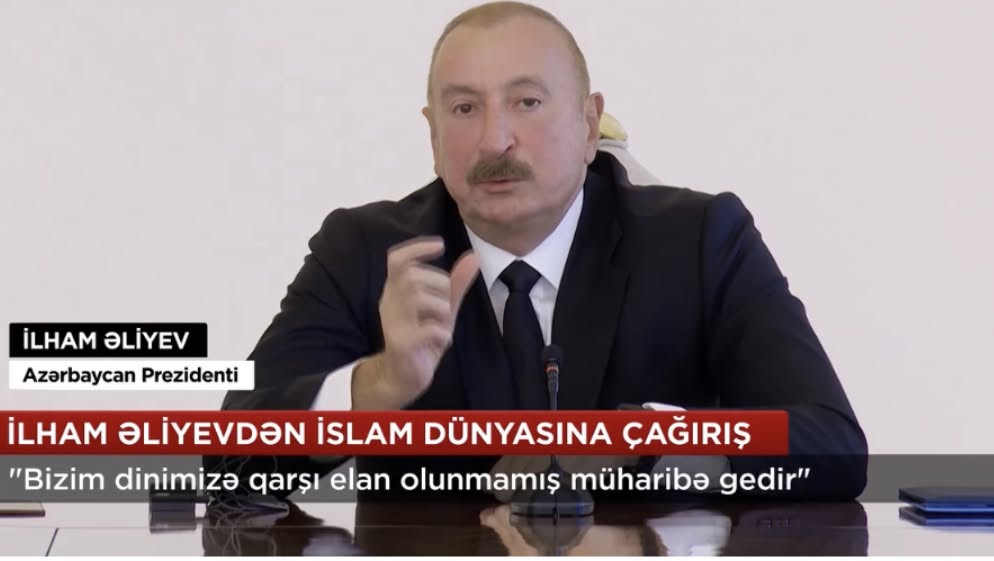
At the same time, the authorities understand the role of religion and seek to exploit it in their propaganda campaigns. As a result, Heydar Aliyev, the former leader of the Communist Party of Azerbaijan who fought against religion during the Soviet era, was instantly transformed during the independence period into a “truly devout Muslim”. His son is following in his father’s footsteps. While fighting for a “secular Azerbaijan”, he builds new mosques, visits mosques with his family and prays. Of course, all this is for show, a publicity stunt aimed at the domestic population. Ilham Aliyev and his family members do not even know how to pray properly. But they do go to mosques! Moreover, Ilham Aliyev has increasingly presented himself in recent times as a defender of Islam. Exactly one month ago, he even declared emphatically: “A targeted war is being waged against our religion, our values and the Holy Quran.”
But something else is far more important. In 2010–2011, protests took place in Azerbaijan against the ban on wearing the hijab in educational institutions. At the time, these events provoked a strong negative reaction in Iran, including at the state level. Turkey, however, which is also an Islamic country, did not react in the same way, even though Erdoğan, who had long presented himself as a defender of Muslims in the Middle East, was already leading the country.
Today, the situation is precisely the opposite. Iran’s reaction to the hijab ban in Azerbaijan has been muted, amounting to little more than a routine statement issued for appearances’ sake. One of Iran’s influential figures, former Vice President and Foreign Minister Javad Zarif, even spoke out just two days ago against threatening Azerbaijan over the hijab issue! And yet the protests in Azerbaijan, as well as law enforcement actions against the demonstrators, involve segments of the country’s Shiite population. Nevertheless, the authorities and government propagandists consistently blame Iran for everything that is happening in the country in connection with the hijab issue.
Another curious detail is that in 2011, one of Azerbaijan’s respected theologians, Abgül Suleymanov, was arrested for participating in protests against the hijab ban and sentenced to 11 years in prison. He was released in 2022, and now he has been arrested again for the same reason. This time, however, he was sentenced to 30 days of administrative detention — an extraordinary display of leniency in present-day Azerbaijan when it comes to believers, especially a theologian!
There is yet another curious detail. Since the hijab crisis began on 21 September, the authorities have released 21 Shiite believers from prison.
In other words, it is quite clear that Azerbaijan and Iran have no desire to quarrel over the hijab ban.
The same cannot be said, however, about relations between Azerbaijan and Turkey, which are in fact the main reason behind the current upheaval surrounding the hijab issue. The Azerbaijani authorities, aware of the public’s sympathy for Turkey, tried for a long time to conceal the problems and pretend that all was well in Azerbaijani-Turkish relations. In Turkey, however, experts and journalists, including those close to Erdoğan, have repeatedly written and spoken about these problems, particularly after the 44-day war and the end of the Karabakh conflict.
After all, it was thanks to Turkey and Erdoğan personally that serious negotiations between Azerbaijan and Armenia got underway. Erdoğan was also able to secure Trump’s interest and bring him into the negotiations. Turkey’s objective was clear: peace between Armenia and Azerbaijan would automatically pave the way for normalised neighbourly relations between Turkey and Armenia. This, in turn, would allow Armenia to act with greater confidence and eventually lead to the closure of the Russian military base in the city of Gyumri. In other words, peace with Armenia would fundamentally transform the geopolitical situation in the South Caucasus and push Russia out of the region.
But Aliyev acts with one eye on Putin and has therefore been in no hurry to pursue peace negotiations. At the same time, he has opposed the normalisation of relations between Turkey and Armenia. As long as the Karabakh conflict remained unresolved, Turkey tolerated these demands from Azerbaijan. But now that Karabakh has returned to Azerbaijani control and the conflict has ended, the situation has increasingly begun to irritate Turkey. Voices in Turkey have become more openly critical, arguing that Azerbaijan has begun treating Turkey the way Israel treats the United States — in other words, the policy of the more powerful country is being held hostage to that of the weaker one.
Nevertheless, Aliyev continues to look primarily northwards, towards Moscow, and remains in no hurry to sign a peace agreement with Armenia.
Meanwhile, Turkey’s already strained relations with Israel deteriorated further and became openly hostile. Yet Azerbaijan did not side with Turkey on this issue either. Tensions escalated rapidly, and Azerbaijan’s representative’s refusal to leave the UN General Assembly Hall before Israeli Prime Minister Benjamin Netanyahu’s speech provoked an outburst of indignation in Turkey, particularly among Erdoğan’s supporters. Protests against Azerbaijan followed, along with attacks on Ilham Aliyev.
The Azerbaijani authorities had to respond to all this. Dealing with Iran is straightforward for them: at the slightest pretext, they can arrest large numbers of their own Shiite believers. But Turkey is a different matter. Azerbaijan has Sunni Muslims, but not all of them have ties to Turkey. Those who do include supporters of the late Fethullah Gülen, who are, however, opponents of Erdoğan. Arrest Turkish citizens? But Turkey is not France; such a move would not be understood by Azerbaijani society.
And so, on 21 September, the hijab issue suddenly emerged — evidently hastily manufactured and artificially stirred up in the middle of the school term, rather than before it began.
Then, on 2 October, at the congress of the ruling party, Ilham Aliyev declared that Azerbaijan had supposedly won the war for Karabakh entirely on its own, that nobody had helped it and that even the weapons it received had been sold at world market prices. This was not merely false information from the Azerbaijani president. It was an attack on Turkey, and an insulting one at that. In reality, throughout Azerbaijan’s years of independence, Turkey had supplied it with weapons at low prices, while some weapons had been provided entirely free of charge. This is not to mention Turkey’s role in reforming the Azerbaijani army.